Home to leading manufacturers, robotics pioneers, infrastructure builders and iconic gaming companies, of course, Japan is one of the world’s centers of AI — building across the full stack with NVIDIA technologies. This week NVIDIA and its partners in Japan are showcasing the AI ecosystem’s latest advancements. Check back here for updates.
Wednesday, July 15, 4 p.m. PT 
Japan’s Leaders Advance Healthcare and Life Sciences With NVIDIA Agentic and Physical AI
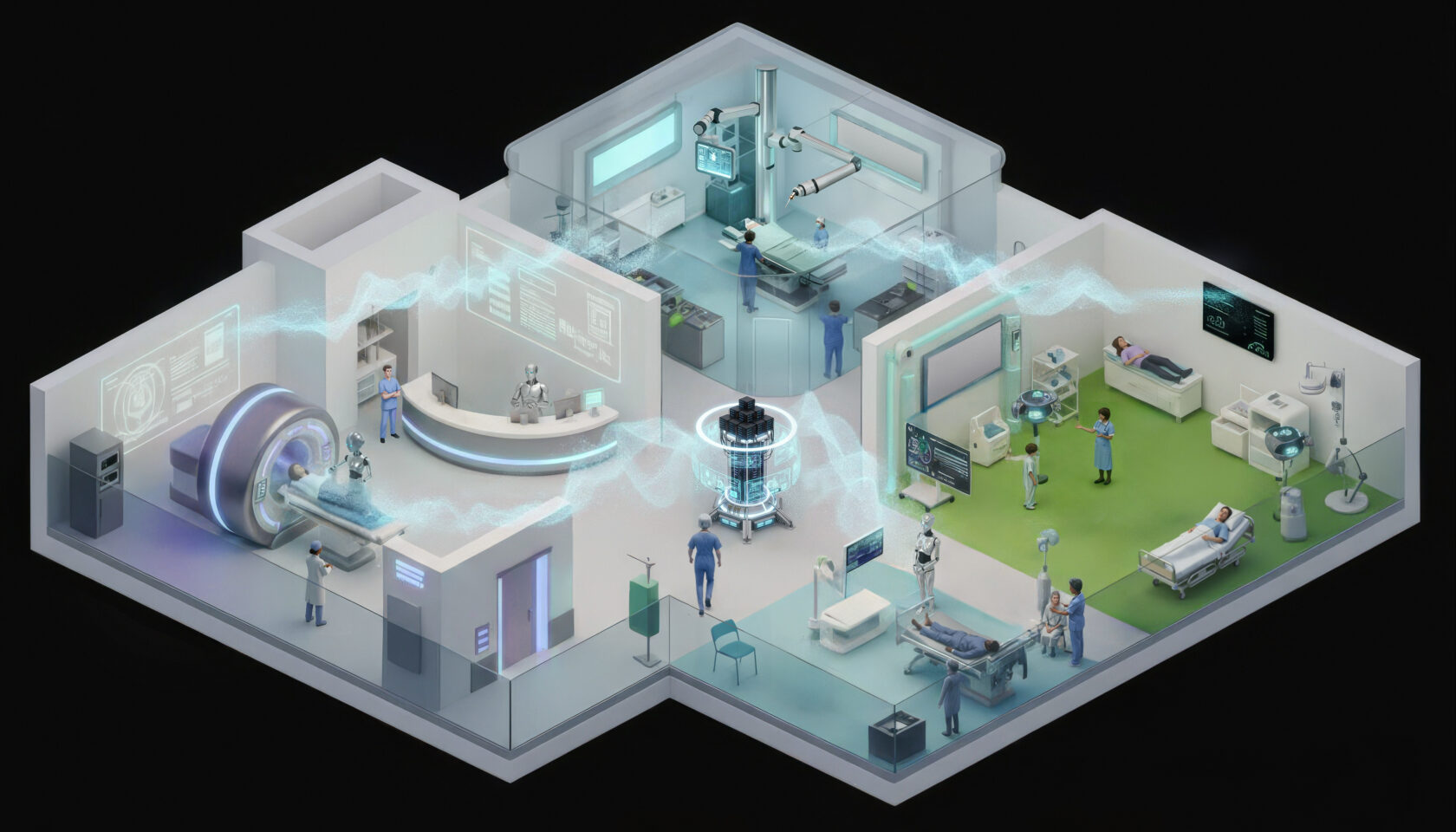
Japan built the world’s most trusted names in medical technology and biopharma. Now the country’s healthcare leaders are engineering the next generational leap with AI, powered by NVIDIA.
From autonomous surgical robots to AI-accelerated CT systems, and from agentic drug discovery platforms to virtual cell models, Japanese innovators are deploying NVIDIA technology to reshape medicine at every level.
Agentic AI Accelerates Japanese Drug Discovery
Japan’s pharmaceutical leaders are uniting around AI-powered drug discovery. Tokyo-1, the AI drug discovery consortium and platform operated by Xeureka, continues to expand, with Eisai joining this past April, bringing together leading pharma companies — Astellas, Daiichi Sankyo and Ono Pharmaceuticals — all advancing drug discovery using NVIDIA BioNeMo.
Astellas has deployed nearly all BioNeMo NIM microservices within NVIDIA’s digital biology portfolio and is running BioNeMo Agent Toolkit, NVIDIA’s open platform that turns any AI agent into an autonomous life sciences scientist. It gives AI agents, software platforms and biopharma systems immediate access to NVIDIA’s full life sciences stack.
Ono Pharmaceuticals is using the Boltz-2 NIM microservice to streamline and accelerate internal drug discovery. Daiichi Sankyo is conducting ultralarge-scale virtual screening on Tokyo-1 and leveraging NVIDIA RAPIDS to accelerate large-scale data processing. Xeureka is using NVIDIA BioNeMo to power its AI-driven drug discovery efforts, enabling researchers the flexibility to use the most appropriate models and tools across diverse discovery programs.
SyntheticGestalt announced two products: the molecular AI foundation model ZAO and the molecular generative model KOYA. ZAO is a foundation model that converts small molecules into data AI can use, through a “4D” representation that captures the multiple 3D conformations a molecule actually adopts; as a single general-purpose model, it ranked No. 1 on nine public drug-discovery benchmark tasks, achieving the world’s best performance.
KOYA is a molecular generative model that designs novel, high-affinity ligands for a target protein while closely reflecting the user’s intent. Both products can be called from the NVIDIA BioNeMo Agent Toolkit, enabling AI agents to carry out everything from evaluating molecules to designing them, and to accelerate drug discovery in collaboration with researchers.
Biomy is pioneering a virtual cell foundation model with a massive clinical dataset from the Japanese Foundation for Cancer Research. Using NVIDIA single-cell RAPIDS, Biomy achieved 90% faster spatial transcriptomics analysis. Biomy will use NVIDIA Nemotron-powered agents to autonomously propose and orchestrate complex virtual experiments for drug development.
Takeda recently announced a collaboration with Boltz to deploy the BoltzMol-1 and BoltzProt-1 biomolecular models across its research organization, giving scientists tools for structure prediction, affinity estimation and generative design that integrate into existing discovery workflows. NVIDIA accelerates these models through NVIDIA BioNeMo with libraries such as cuEquivariance.
Physical AI Enters the Operating Room
Kawasaki Heavy Industries provides technology designed to improve the overall efficiency of hospital operations, including with its FORRO, Nyokkey and NURABOT robots.
The company plans to use NVIDIA Holoscan IGX, Isaac for Healthcare, Isaac GR00T and Cosmos to develop surgical support functions, nursing assistant and hospital transport robots.
Direava is developing a surgical vision language model for real-time surgical video understanding and natural language interaction with surgical scenes. Direava aims to evolve this technology into an intelligence layer for future surgical AI and physical AI in the operating room.
NVIDIA Accelerated Computing Powers Japan’s Next-Generation CT
Two of Japan’s leading medical imaging companies are now shipping next-generation CT systems built on NVIDIA GPUs.
Canon launched Japan’s first NVIDIA-accelerated photon-counting CT system, marking a step forward for the country’s next generation of medical imaging.
Fujifilm has commercialized Japan’s first whole-body CT system powered by NVIDIA Blackwell, using diffusion-based deep learning reconstruction to improve image quality.
The integration of AI and accelerated computing into medical imaging equipment contributes to improved image quality, enhanced accuracy, early detection and higher standards of medical care.
Together, these advances signal a new era: AI, and not just accelerated computing, is no longer an experiment in Japanese healthcare. It’s infrastructure.
Wednesday, July 15, 4 p.m. PT
NVIDIA Metropolis Provides Developers Agent-Ready Libraries to Build NVIDIA Cosmos-Powered Vision AI Agents Faster
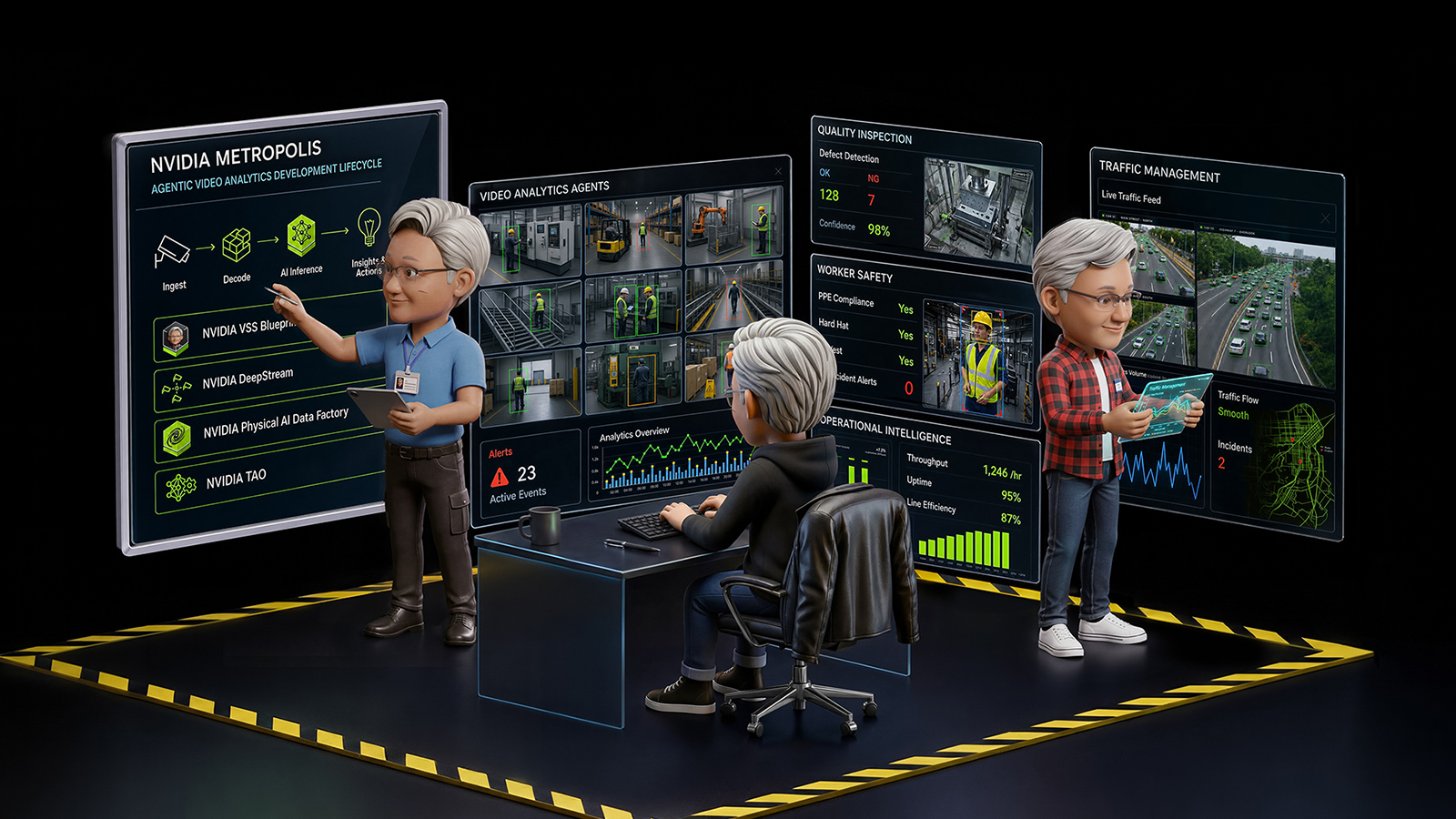
As enterprises capture more video data across the physical world, vision AI is transforming beyond passive perception and dashboards into agentic systems that can understand, reason and act in real time. Powered by reasoning vision language models (VLMs) such as the NVIDIA Cosmos of open models, these agentic systems extract rich insights from video, whether on operations, environmental context or root causes for issues.
Building production-ready, high-accuracy vision AI agents can require thousands of developer hours across data collection, model training, validation and deployment. NVIDIA Metropolis now packages more than 80 new skills, including NVIDIA VSS Blueprint 3.2, NVIDIA DeepStream 9.1, NVIDIA TAO 7 and Physical AI Data Factory, that help developers use coding agents to speed that process by at least 6x.
Japan’s industrial and smart-space leaders including Asilla, AWL, Fujitsu, Hitachi, OMRON, Shimizu Corporation and Yazaki North America are using Metropolis to bring vision AI agents into factories, construction sites, stories, buildings and public spaces.
Metropolis Open Libraries and Skills Span the Vision AI Lifecycle
Metropolis provides a comprehensive set of open libraries and skills that span the entire vision AI development lifecycle, from creating data pipelines to generating synthetic data, fine-tuning models and deploying agents at scale.
New libraries include:
- NVIDIA VSS Blueprint 3.2 helps developers build and operate vision AI agents that can see, reason and act over live or recorded video using natural language. New skills for coding agents make it faster to build and operate custom, always-on video agents that alert, summarize and search across large camera networks.
- NVIDIA DeepStream 9.1 helps developers create and deploy real-time, multi-sensor video analytics pipelines from edge to cloud for large-scale ingestion, multi-camera tracking and operations analytics.
- NVIDIA TAO 7 helps developers customize and optimize NVIDIA Cosmos and other vision AI models with agent skills for labeling, performance diagnostics, fine-tuning, data generation and automated machine learning.
- NVIDIA Physical AI Data Factory skills help developers use NVIDIA Cosmos to automatically generate and augment synthetic image and video data to fill training gaps for rare or new product defects, environmental changes and other edge cases, pushing vision model accuracy to new levels.
Companies Advance Agentic Vision AI With NVIDIA Metropolis
Japan-based companies are using the new NVIDIA Metropolis technologies to bring real-time intelligence to physical operations.
For industrial inspection and operations, OMRON is enhancing automated inspections with VSS-powered video analytics agents.
DeepHow is helping Yazaki North America automate time and motion studies, reducing the current process from weeks to days and unlocking millions of dollars in annual savings.
For smart spaces and public safety, several Hitachi HMAX solutions use VSS-powered agents to generate actionable insights and identify issues in building and rail infrastructure, helping to reduce maintenance costs and energy consumption by 15% in rail applications alone. Fujitsu Kozuchi AI platform combines VSS with its Agentic Memory technology to transform long-duration video into operational knowledge, accelerating decision-making across manufacturing, logistics, retail and smart spaces. Meanwhile, Shimizu Corporation is piloting VSS for construction worker safety.
With DeepStream and VLMs, Asilla is monitoring public spaces and commercial facilities to detect incidents and improve response time, while AWL is building retail and manufacturing solutions with DeepStream.
Developers can access NVIDIA VSS Blueprint 3.2 skills, NVIDIA DeepStream 9.1 skills and NVIDIA TAO 7 skills on GitHub. NVIDIA Physical AI Data Factory and synthetic data generation skills are available through GitHub and can be explored using Physical AI Launchables on NVIDIA Brev.
Wednesday, July 15, 4:00 p.m. PT
Japanese Megabanks Build Financial Intelligence With NVIDIA Nemotron and NVIDIA Agent Toolkit
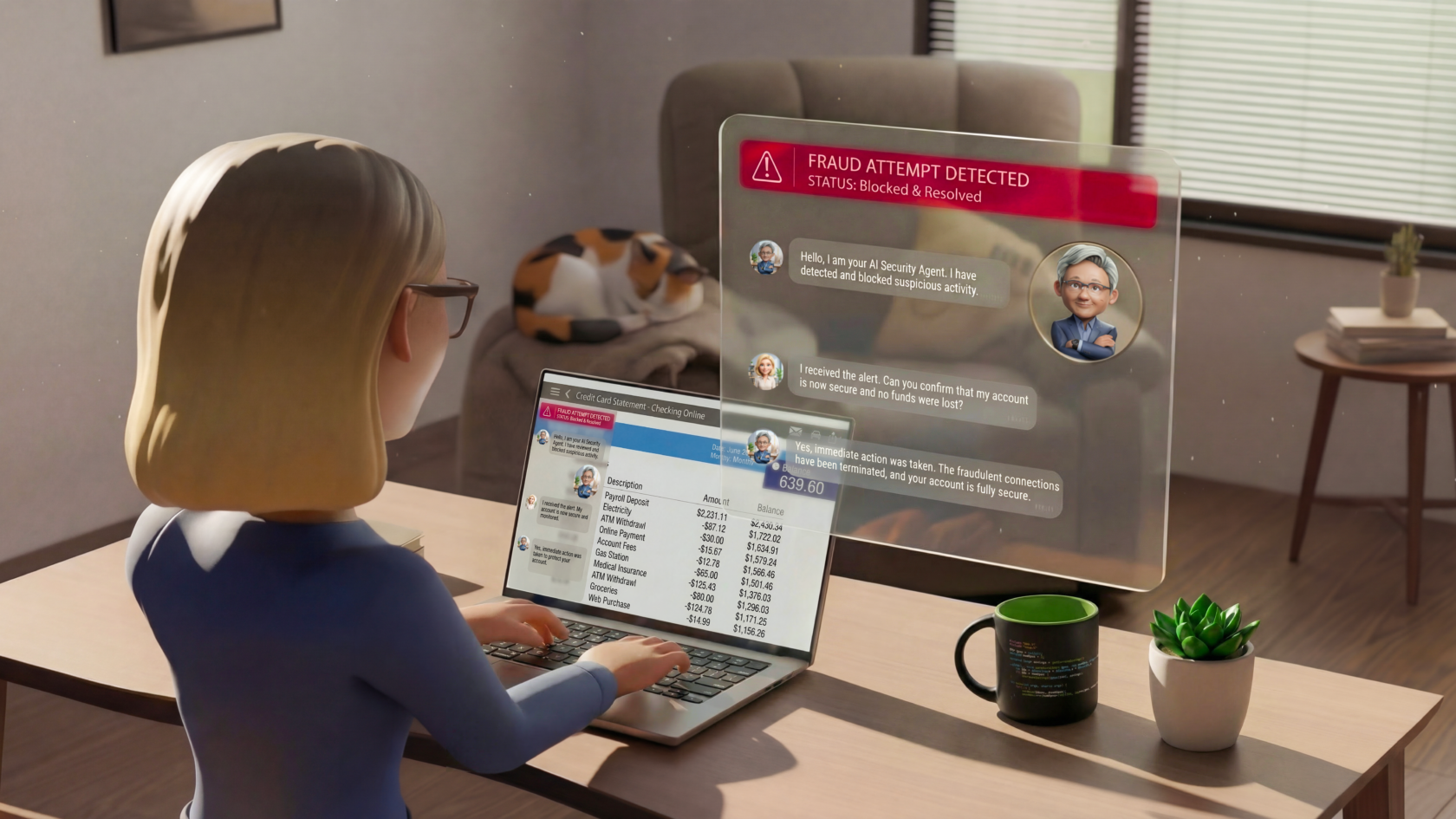
Across Japan, leading banks and financial technology companies are building AI factories and models to deliver financial intelligence. NVIDIA Nemotron open models and NVIDIA Agent Toolkit are helping them turn regulated financial data into valuable intelligence.
In banking, the most powerful AI applications may not look like chatbots. They look like safer payments, smarter fraud detection, faster software development and more personalized financial services, all built on trusted data.
Mizuho plans to build what is expected to be the largest on-premises AI factory in Japan’s financial industry, starting with NVIDIA DGX B200 systems and scaling toward a larger cluster. For a bank handling sensitive financial workloads, being on premises matters: it gives teams a foundation to develop agents with NVIDIA Agent Toolkit and NVIDIA NemoClaw blueprints, while keeping critical data close and secure.
With this secure foundation, Mizuho aims to safely expand the operational scope of these autonomous agents into core workflows, including information gathering, document creation, analysis and system development support, while ensuring rigorous governance and auditability.
As the core IT company of SMBC Group, the Japan Research Institute (JRI) deployed an AI factory to transform financial data into intelligence using NVIDIA Nemotron open models. As one of Japan’s largest financial groups, SMBC Group’s adoption shows how open models and accelerated infrastructure can help established institutions move AI from experimentation into production-ready enterprise workflows. The initiative serves as a foundation for scaling AI adoption across the SMBC Group, improving productivity, accelerating innovation and delivering better financial services to customers.
Rakuten Bank brings digital-native scale to the same transformation. Using the Rakuten Group’s ecosystem, which spans more than 70 services and includes over 18 million banking accounts, 33 million credit cards and 14 million brokerage accounts, Rakuten Bank will develop transaction foundation models built with NVIDIA Agent Toolkit, helping turn high-volume consumer financial data into specialized intelligence for banking services.
Ippu Senkin is collaborating with a financial institution to build sovereign financial intelligence with NVIDIA Blackwell GPUs and Local AI Agent, a local coding agent developed by Ippu Senkin using NVIDIA Agent Toolkit, Nemotron and NemoClaw for secure payment operations within the institution’s group. The effort points to a broader ecosystem motion with AI-native partners helping financial services companies build local agents and applications that can run on local AI factories.
Japan’s financial services industry is moving from model pilots to AI infrastructure that can support regulated, domain-specific intelligence. Banks need performance, governance and proximity to data; digital banks need model-building capacity at transaction scale; and AI-native partners need a platform for local financial agents.
NVIDIA provides a full stack across those paths, from accelerated computing and AI factory architecture to Nemotron open models and Agent Toolkit for building agents and specialized financial intelligence.
Learn more about how financial institutions are transforming financial data into intelligence with transaction foundation models.
Wednesday, July 15, 4:00 p.m. PT
NVIDIA Advances Japan’s World-Class Quantum and AI for Science Capabilities
NVIDIA is advancing a historic partnership between the U.S. and Japan, its first international partner in the Genesis Mission.
Genesis Mission’s large-scale initiative to harness AI for scientific discovery calls on U.S. labs and industry, as well as international collaboration.
NVIDIA and Japan are answering the call — from AI to quantum computing.
NVIDIA and RIKEN Driving AI for Science
At RIKEN, Japan’s leading national comprehensive research institute, two supercomputers driven by NVIDIA GB200 and NVIDIA Quantum-X800 are beginning operations.
RIKYU, a new supercomputer for “AI for Science” development, deploying 1,600 NVIDIA Blackwell GPUs using the GB200 NVL4 platform, will support RIKEN’s development of open foundation models and contribute to accelerating AI adoption across broad fields, including life sciences, materials science and laboratory automation.
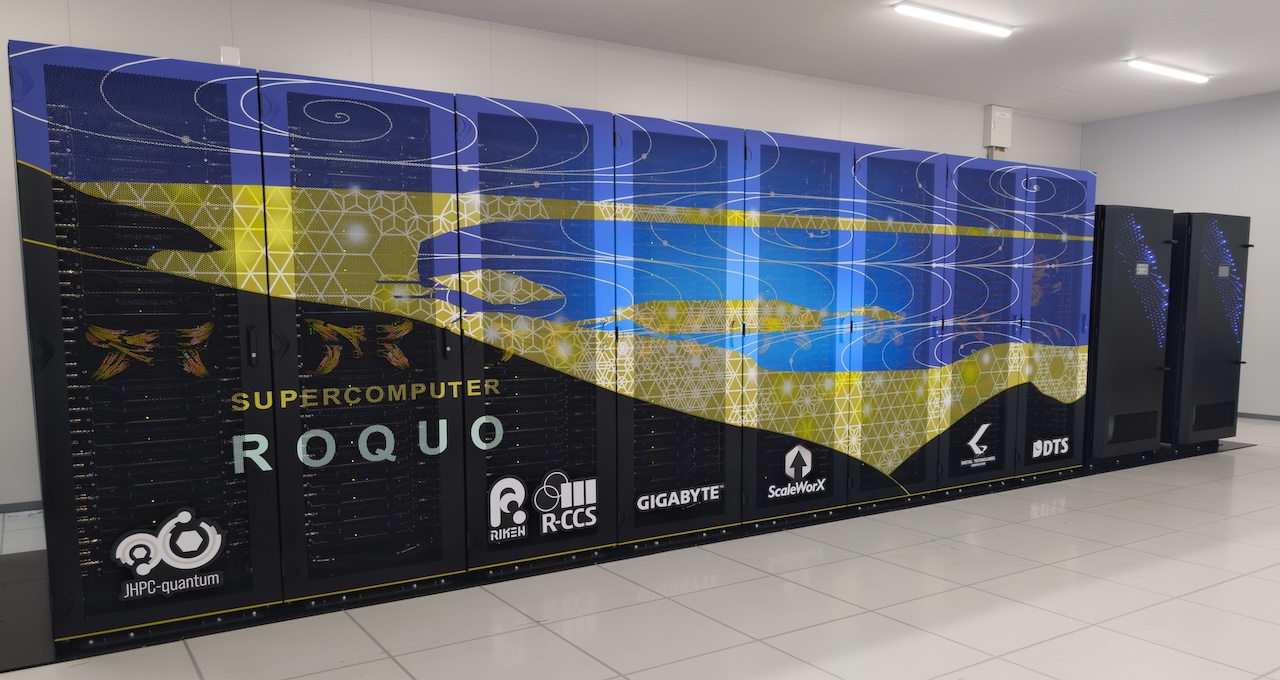
JHPC-quantum GPU supercomputer “ROQUO” is a quantum-HPC system tightly integrating quantum processors with accelerated computing from 540 Blackwell GPUs accessed through the GB200 NVL4 platform. ROQUO is connected to on-premises quantum computers at RIKEN’s facilities in Wako and Kobe, Japan — including Quantinuum’s trapped-ion Reimei system, enabling hybrid quantum-HPC workloads. In ROQUO’s first months of operation, researchers are beginning to explore an evolutionary AI framework, developed with NVIDIA and integrated with the NVIDIA CUDA-Q platform for quantum-classical computing, to generate quantum circuits for the Reimei system.
Building an Ecosystem That Brings AI to Quantum
AI is the unlocking technology for scaling quantum processors into useful quantum-GPU supercomputers, but the adoption of AI in quantum computing workflows remains a key challenge.
At the National Institute of Advanced Industrial Science and Technology’s (AIST) Global Research and Development Center for Business by Quantum-AI Technology (AIST G-QuAT), NVIDIA is working to bring state-of-the-art AI to the center’s current and future quantum processor systems. NVIDIA NVQLink provides the low-latency connection between GPUs and quantum processors, while NVIDIA Ising open models support automated QPU calibration and AI-based decoding for quantum error correction.
Advancing Quantum Chemistry
High-accuracy simulations of chemical systems are fundamental for next-generation research in areas such as materials science and drug discovery. AI approaches can expand what quantum algorithms are capable of, improving how these simulations scale.
Mitsubishi Chemical, Mizuho Bank, Keio University, AIST, the University of Toronto and NVIDIA have demonstrated an AI- and GPU-driven workflow for harnessing quantum processors in molecular spectral analysis — a key tool for understanding the electronic structure and properties of molecules and materials. NVIDIA GPUs achieved a 13.4x speedup for this workflow over CPU-only nodes. Accelerating this analysis lets researchers apply it more quickly to early targets, like extreme ultraviolet photoresist for semiconductor manufacturing.
Developing useful quantum chemistry applications also means building workflows suitable for tomorrow’s large-scale hybrid quantum-GPU supercomputing systems. Fujitsu and NVIDIA are now investigating efficient ways to use NVIDIA CUDA-Q for large-scale quantum-chemistry simulation. Through the collaboration, Fujitsu has started the trial of NVQLink to determine if it can be utilized to realize efficient control of their quantum-classical hybrid computing environment.
Together, the U.S. and Japan are building on the NVIDIA platform to develop a shared foundation for useful, large-scale quantum computing and AI-driven science, and uniting industry, academia and government.
Wednesday, July 15, 4:00 p.m. PT
NVIDIA Expands Partnership With Toyota to Advance Physical AI Across Automotive, Robotics and Cities
From self-driving cars to cities, the next era of mobility will be defined by AI-enabled systems that can perceive, reason and safely act in the physical world. Toyota and NVIDIA are working together to build that future — connecting AI across vehicles, infrastructure and industrial operations.
This builds on last year’s announcement that Toyota will develop next-generation vehicles with advanced driver-assistance capabilities (L2++) built on NVIDIA DRIVE AGX and running the safety-certified NVIDIA DriveOS operating system.
NVIDIA has enabled Toyota to tap into NVIDIA accelerated computing, AI software and simulation technologies to develop safer, more intelligent vehicles, optimize automotive engineering workflows, fine-tune factory operations and power urban intelligence systems, in support of the company’s vision for safer mobility.
“Physical AI will bring intelligence to every moving machine from cars, robots and trucks to the cities and factories they operate in,” said Rishi Dhall, vice president of automotive at NVIDIA. “Together, Toyota and NVIDIA are building the AI infrastructure for a new era of mobility, where vehicles can become more autonomous, manufacturing more AI-defined and urban environments more intelligent, responsive and safe.”
NVIDIA and Toyota’s latest work spans:
- Accelerating safe, intelligent vehicles: Toyota is building next-generation vehicles with advanced driver assistance capabilities using NVIDIA DRIVE AGX running the safety-certified NVIDIA DriveOS operating system. These vehicles will deliver L2++ functionality, enabling more intelligent, context-aware driving while maintaining Toyota’s rigorous safety standards.
- Software engineering: As vehicles become increasingly software-defined, Toyota is accelerating vehicle software engineering with a MISRA-compliant Code Assistant AI model, trained and fine-tuned using NVIDIA Megatron-LM, and referencing various datasets including NVIDIA Nemotron. By applying a custom automotive AI model to improve automotive-specific code generation and review, Toyota engineers can generate, review and validate safety-critical code more efficiently, accelerating development while adhering to stringent automotive compliance.
- Factory simulation: Toyota is bringing simulation to the manufacturing floor using NVIDIA Omniverse libraries and the NVIDIA Isaac Sim open framework for factory and robotics workflows, robot movement simulation and broader digital twin environments to optimize manufacturing operations. This simulation-first approach reduces downtime, improves efficiency, lowers costs and enables continuous optimization across production environments.
- Multimodal Vision Language Model: Woven by Toyota (a Toyota subsidiary), has developed Woven City AI Vision Engine, a multimodal vision language model for urban traffic intelligence, using NVIDIA H100 Tensor Core GPUs and Megatron-Core. The model is designed to help interpret real-world conditions, anticipate what happens next and support responses across mobility and infrastructure systems.
Wednesday, July 15, 3 a.m. PT
NVIDIA and SEGA Celebrate 30 Years of Innovation, Bringing ‘VIRTUA FIGHTER CROSSROADS’ and Other Legendary SEGA Games to NVIDIA RTX Spark
NVIDIA and SEGA are celebrating more than three decades of collaboration by bringing VIRTUA FIGHTER CROSSROADS and future SEGA titles to NVIDIA RTX Spark — a new superchip for slim Windows laptops and compact desktop PCs.
This builds on the companies’ long-standing relationship, which began 30 years ago when NVIDIA worked with SEGA on burgeoning graphics technology for arcade systems and gaming consoles — with the NVIDIA NV1 chip powering the first Virtua Fighter title on PC, among the world’s first 3D fighting games.
SEGA will support RTX Spark, giving gamers new ways to experience SEGA’s iconic franchises, including the upcoming VIRTUA FIGHTER CROSSROADS.
Announced from the heart of Akihabara, a global gaming technology hub, at the original SEGA Akihabara Arcade (now GiGO Akihabara 3), VIRTUA FIGHTER CROSSROADS coming to RTX Spark reinforces the companies’ commitment to innovation and shows a glimpse of the future of gaming on a new era of Windows PCs designed for personal agents, AI, creating and gaming.
NVIDIA founder and CEO Jensen Huang joined SEGA CEO Haruki Satomi; SEGA chief operating officer Shuji Utsumi; Yu Suzuki, creator of Virtua Fighter; and former SEGA President Shoichiro Irimajiri, at the birthplace of countless arcade memories to celebrate the milestone.
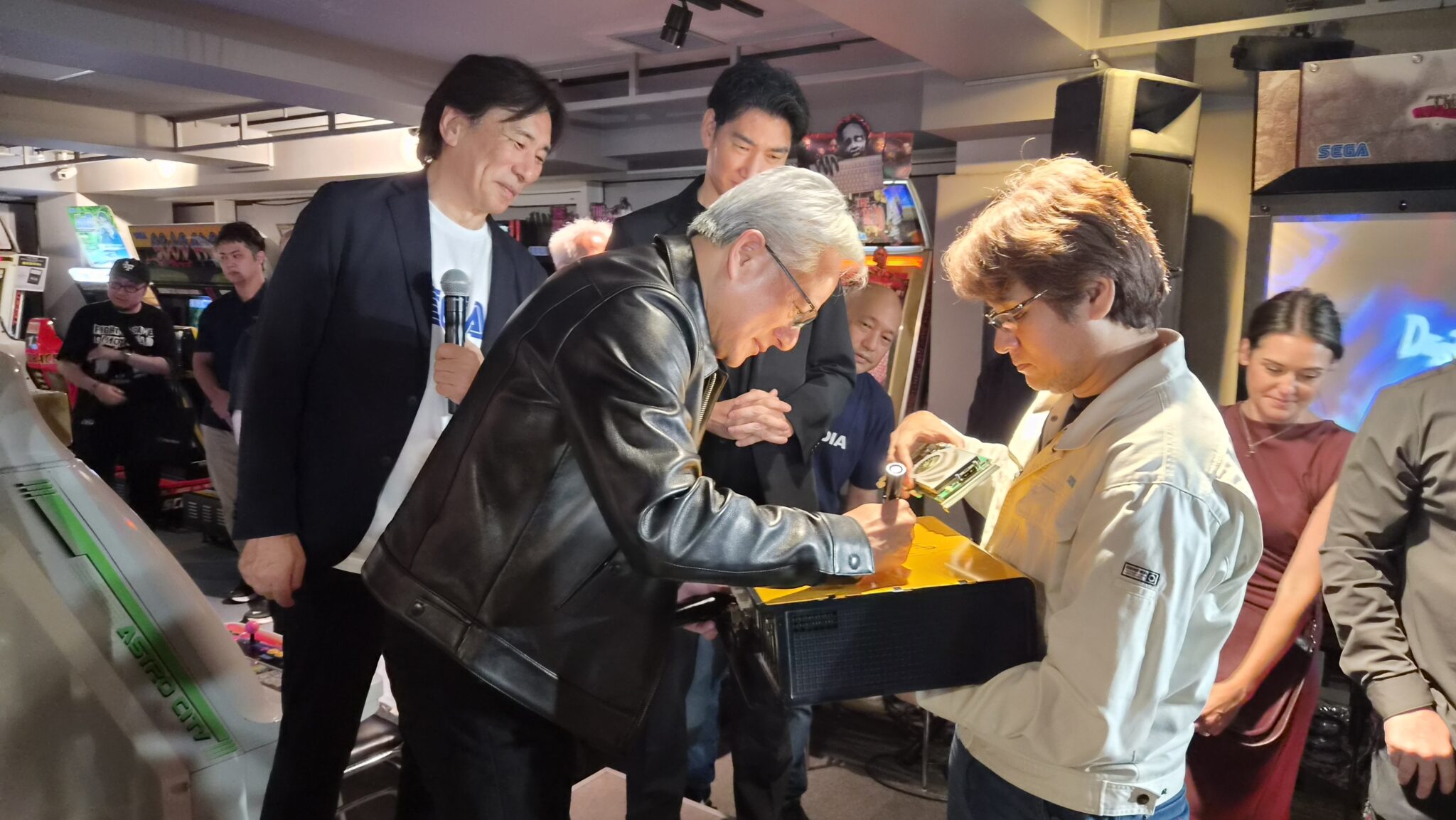
They showcased how technology partnerships can evolve across generations of hardware and software, connecting the gaming industry’s heritage with its future.
The expanding NVIDIA RTX Spark ecosystem — including SEGA and other industry leaders — will offer gamers new experiences harnessing NVIDIA ray tracing, DLSS and AI technologies, while preserving and celebrating the iconic franchises they know and love.
Learn more about NVIDIA RTX Spark.